

Table of Contents
- Why Is SEO Measurement Breaking in the AI Search Era?
- The Fundamental Shift: From Pages Competing → Sources Being Chosen
- The 4 KPI Categories That Actually Matter in AI Search
- KPIs You Should Stop Obsessing Over (But Not Ignore Completely)
- How These KPIs Change SEO Strategy in 2026
- Common Mistakes Brands Make When Measuring AI Search Performance
- Tools to Measure Your AI Search Performance
- Conclusion
In today’s digital world, search has changed significantly. Traditional search engines like Google are rapidly evolving into AI-powered platforms. Features like Google AI Overviews, along with AI-native tools like ChatGPT and Perplexity AI, are fundamentally changing how users find and consume information. This means that the relevance of the metrics that once led to SEO success is being redefined.
With the advent of AI, users do not always need to visit specific websites during the search. They can easily obtain the information they want directly from AI-generated overviews, answers, snippets, voice assistants, or the embedded systems in apps.
Relying entirely on the old-school SEO method of “rank high, get clicks, convert” does not work anymore. So, if your business is still measuring success by the same KPIs as you did years ago, then you are behind your competitors, who are already using AI-driven SEO KPIs.
Therefore, this blog will delve into the SEO KPIs that matter in AI search.
Why Is SEO Measurement Breaking in the AI Search Era?
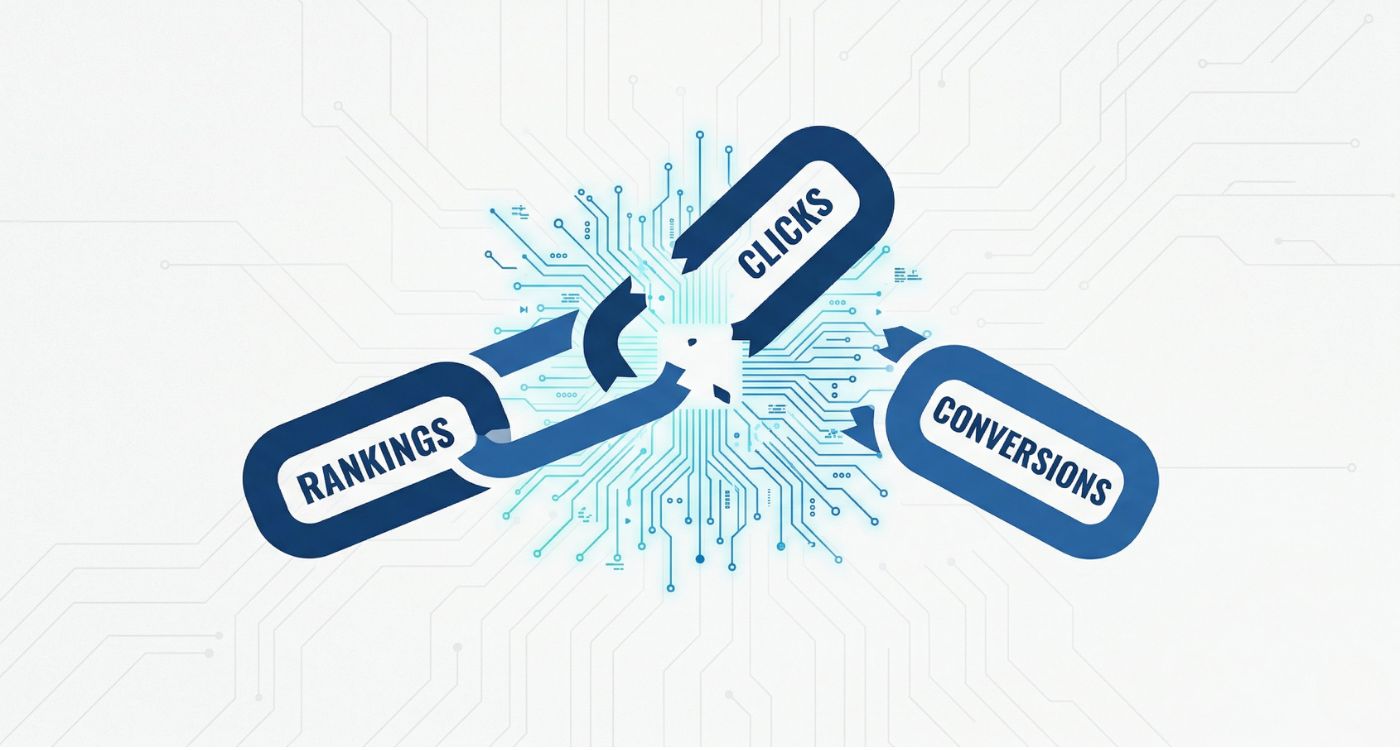
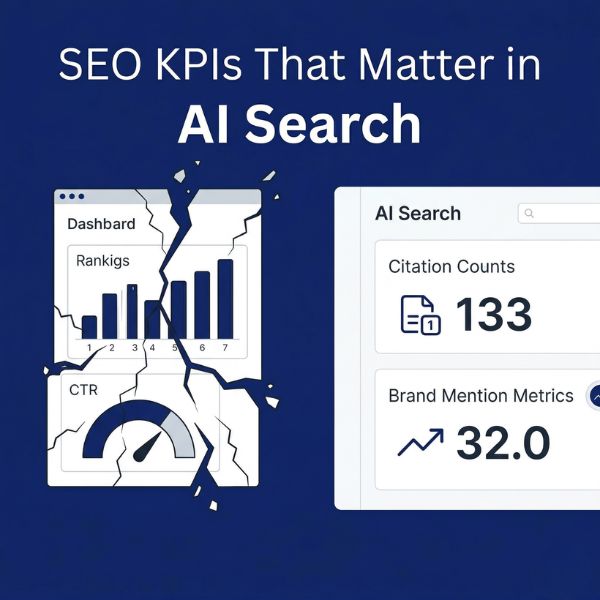
SEO measurement in the AI search era is truly redefining the relevance of traditional SEO metrics. AI is completely reshaping SEO by breaking the conventional link between rankings, clicks, and conversions. For several years, traditional SEO has focused on tracking indicators like click-through rate (CTR), bounce rate, and average ranking position as key indicators of success in the SERPs.
However, in the world of AI search engines, these metrics are not enough. Not because they are useless, but because they measure something that is not vital for today’s search results. The emphasis on blue links is also decreasing as search engines provide AI-generated summaries. Visibility is no longer just about ranking higher in the search results; it’s about retrievability, contextual understanding, and attribution in AI environments.
Hence, in 2026, measuring SEO success demands a new approach. This means businesses now need to use SEO metrics beyond rankings, with new SEO KPIs that reflect how people and machines are engaging with content today.
New, more refined metrics should gradually replace the old SEO indicators. It involves understanding metrics such as citation rate, AI visibility index, Generative Share of Voice (GSoV), and AI answer inclusion rate. This does not mean that SEO is dying; this means that it is just being redefined.
The Fundamental Shift: From Pages Competing → Sources Being Chosen
The digital landscape is experiencing a fundamental shift in SEO and Google’s search engine behaviour, in which the traditional model, where individual pages used to compete for keyword rankings, is giving way to one in which authoritative sources are selected and synthesized by AI-driven engines.
The Old Way: Pages Competing
Businesses used traditional SEO for several years, focusing on backlinks, keyword density, and especially optimising individual pages to achieve higher rankings than competitors for particular search terms. This also led to keyword cannibalization, where multiple pages on the same site competed for the same query, resulting in lower rankings for all of them. The primary goal was to rank at the top for the specific keyword phrase.
The New Way: Sources Being Chosen
Meanwhile, the SEO KPIs for AI search engines focus on gathering information from various sources. AI-powered search engines like Google AI Overview, ChatGPT, and Perplexity AI prioritise sources that show high topical authority and trustworthiness.
These engines draw on multiple sources to compile information and create a summarised answer. A key factor about these engines is that they often cite sources from websites that might not appear in the traditional top results. By understanding the intent behind the query, the AI engine selects the best source to meet the user’s needs.
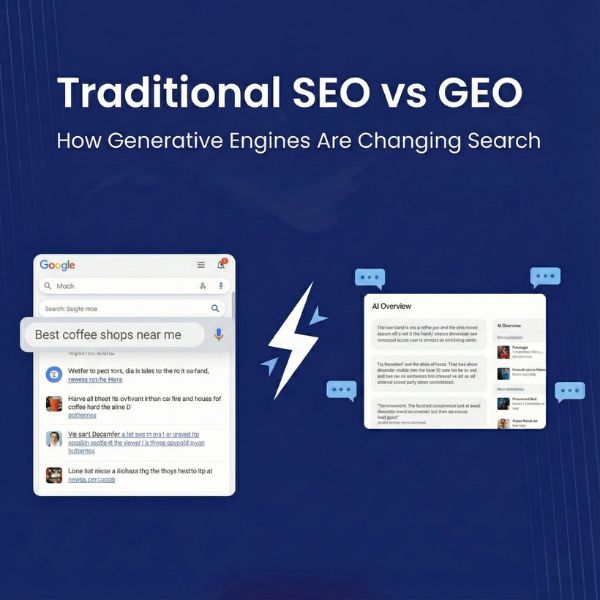
This shift is most visible in the rise of AI Overviews and has given rise to Generative Engine Optimisation (GEO) as a strategic discipline. Success is no longer measured purely by holding top positions in the SERPs. Instead, it is increasingly measured by a brand’s ability to be cited as a trusted and expert source. Thus, businesses should now focus more on SEO KPIs without rankings.
The 4 KPI Categories That Actually Matter in AI Search
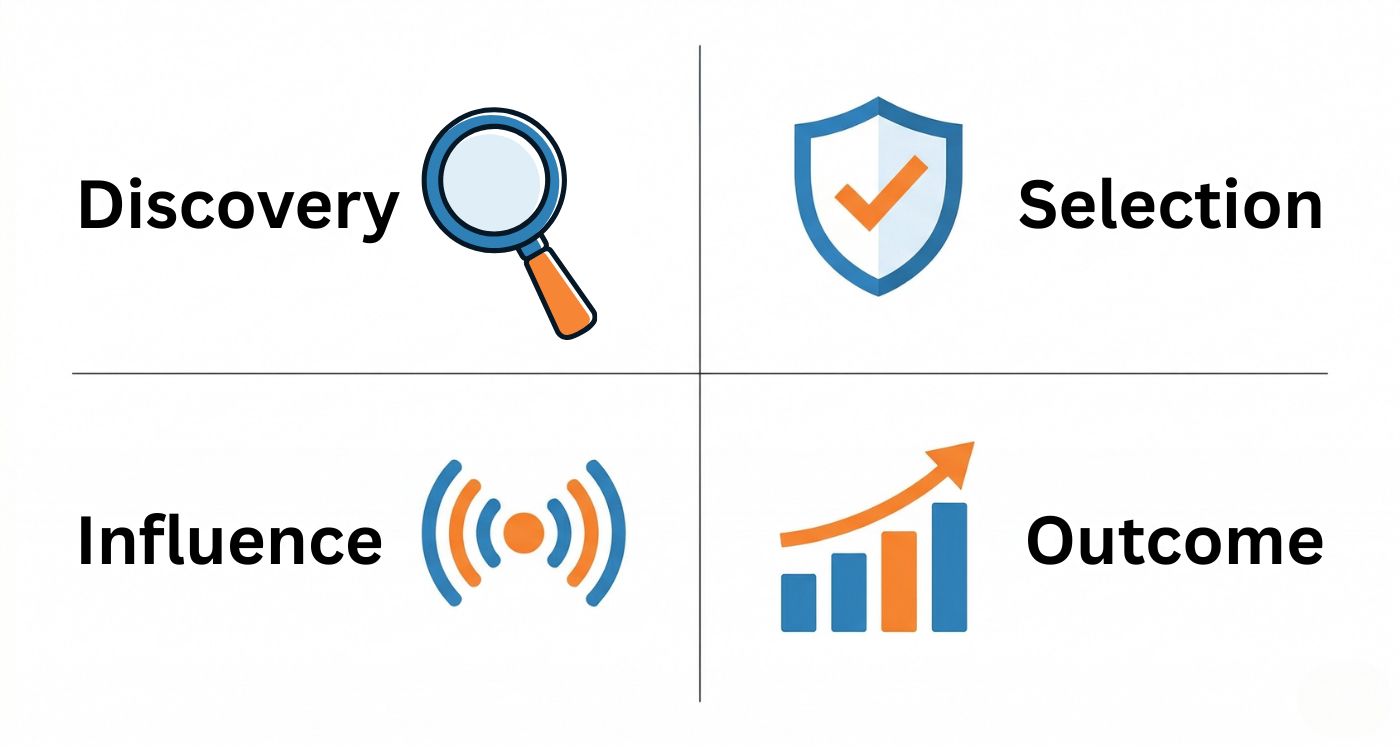
Here are the SEO KPIs that matter in AI search:
Discovery KPIs – “Can AI find and understand you?”
In AI-driven SEO, success is defined by key metrics that go beyond simple rankings. The discovery KPIs measure your brand’s visibility and influence in AI-generated answers from engines like ChatGPT, Perplexity, and Google AI Mode. There is a shift in focus from clicks to appearance in AI answers, tracking metrics like citation frequency, mention rate, and Share of Answer that traditional analytics can’t capture.
These metrics simply measure how visible your brand or content is to the AI platforms. It mainly focuses on whether AI can discover and understand content thoroughly to use it effectively. As a result, the search is shifting from a list of links to AI-summarized answers. Hence, in AI search, the new goal for every business should be to prepare SEO KPIs for zero-click searches.
Key metrics to track under Discovery:
AI Brand Mention Rate: The percentage of AI-generated responses for relevant queries that mention your brand by name.
Share of Answer (SoA): How often your content appears within AI-generated answers for a defined set of target queries.
Prompt Coverage Rate: The number of relevant queries for which your brand appears in any AI response, out of total queries tested.
Tools: Otterly.ai, Peec.ai, Brandwatch, or manual prompt testing across ChatGPT, Perplexity, and Google AI Overviews.
Selection KPIs – “Does AI trust you enough to use you?”
The selection KPIs measure authority, visibility, and engagement within AI-driven search. They measure whether large language models (LLMs) like AI Overview, ChatGPT, and others choose your content to answer user queries. Businesses investing in llm seo services are better positioned to influence these selection signals early. This shifts your focus from achieving the number one ranking on the SERPs to becoming a trusted source that AI models select, cite, and recommend in their generated answers.
Key metrics include AI answer attribution rate, AI snippet appearance rate, and sentiment analysis of AI-generated responses, all of which assess real performance in AI environments beyond traditional keyword rankings.
Key metrics to track under Selection:
AI Answer Attribution Rate (AAAR): The percentage of AI responses where your content is explicitly cited or linked as a source.
AI Snippet Appearance Rate: How often a direct excerpt from your page appears within an AI-generated answer.
Sentiment Score in AI Responses: Whether the AI describes your brand positively, neutrally, or negatively when it does mention you.
Tools: Google Search Console (for AI Overviews appearances), Semrush AI Toolkit, Peec.ai, or manual prompt audits.
Influence KPIs – “Are you shaping AI answers?”
Influence KPIs measure how effectively your content appears and drives value in the AI-driven search. This includes shifting from traditional metrics like rankings to signals such as AI signal rate, attribution accuracy, citation frequency, and chunk retrieval frequency.
These KPIs focus on achieving brand presence in AI answers, semantic density, and the overall impact of conversions from this AI-influenced traffic. They go beyond clicks by focusing on AI’s influence and usefulness.
Key metrics to track under Influence:
Citation Frequency: How many times your domain is cited across a batch of tested AI prompts. Track this weekly to spot gains or drops.
Semantic Density Score: Whether your content uses the same entities, concepts, and language that AI models associate with your topic.
Chunk Retrieval Rate: How often a specific section or passage from your page is extracted and surfaced in an AI answer.
Tools: Otterly.ai, Surfer SEO (for semantic density), or manual prompt testing with tracked query sets.
Outcome KPIs – “Is AI visibility driving business value?”
Outcome KPIs measure the direct business impact, like ROI, sales, etc., and new AI-specific visibility, like attribution, semantic relevance, and brand mentions in AI answers, beyond traditional SEO. It simply means tracking if your company’s appearance in AI-generated search leads to real business results.
These KPIs bridge the gap between technical AI visibility and tangible business value.
Key metrics to track under Outcome:
AI Referral Traffic: Direct sessions arriving from ChatGPT, Perplexity, or other AI platforms. Track this as a separate segment in GA4.
AI-Influenced Conversion Rate: The conversion rate of users who arrived via AI referral sources versus traditional organic traffic.
Brand Search Lift: An increase in branded keyword search volume following a period of strong AI citation activity, indicating that AI exposure is driving awareness.
Tools: GA4 (traffic source segmentation), Google Search Console, Google Trends for branded query tracking.
KPIs You Should Stop Obsessing Over (But Not Ignore Completely)
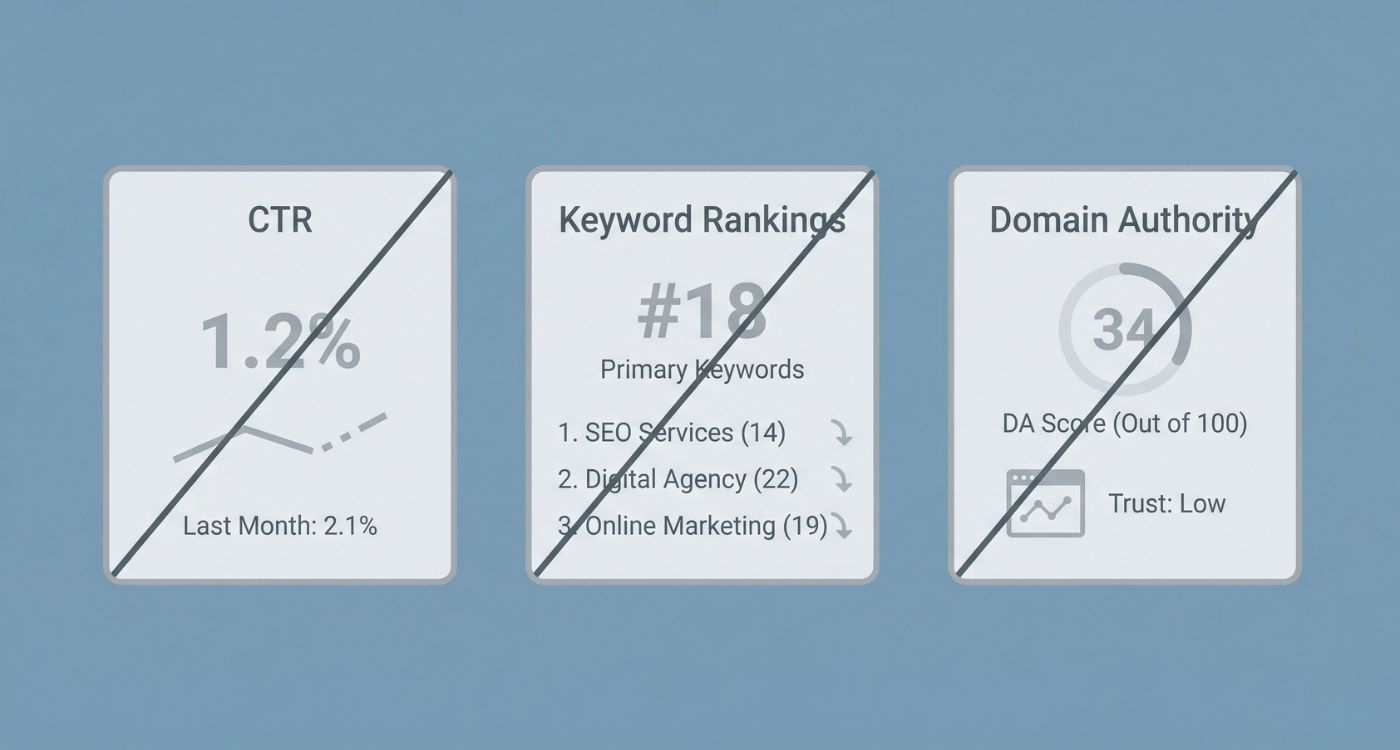
1. Click-through rate (CTR):
Why: In AI search, zero-click behaviour is the dominant pattern. Users receive synthesised answers directly in AI Overviews, ChatGPT, or Perplexity without ever visiting a website. In this environment, a low CTR may no longer indicate a weak listing; it may simply reflect where the answer was delivered. Tracking CTR in isolation becomes misleading. Use it alongside brand mention rate and AI citation frequency for a more complete picture. This is especially important in AI search, where zero-click searches are gradually dominating search results.
This is because search engines directly answer queries in summarized responses in the Google AI Overview. However, you can use this to monitor overall brand visibility trends.
2. General Keyword Rankings:
Why: Due to AI search results, ranking at the top for high-volume keywords does not guarantee traffic or revenue anymore. Moreover, tracking individual keywords can be less effective than focusing on semantic authority. But you can monitor it for transactional or bottom-of-the-funnel keywords that directly align with your business offerings, and for local intent queries where local seo ranking factors still play a significant role in determining visibility.
3. Domain Authority:
Why: DA is not a direct Google ranking factor; it is a third-party metric created by Moz. It has never reliably predicted rankings, and its relevance diminishes further in AI-driven search where topical authority and entity trust matter more than a single composite score. Use it only as a rough benchmarking tool when comparing your site against competitors, not as a primary performance indicator.
How These KPIs Change SEO Strategy in 2026
Here’s how AI search SEO metrics are changing SEO strategy in 2026:
- Search engines now understand intent, not just keywords. They no longer rely solely on keyword matching. You should change your SEO strategy by understanding what problem the user is trying to solve and structuring your page to address it directly. You don’t win rankings anymore; you win by answering the question better than anyone else.
- Optimising content for AEO and GEO has become essential. You should structure your content for extraction, using natural language that closely matches user search queries. To appear in AI-generated summaries, your page should provide direct answers near the top within 120–150 words.
- Content depth and readability directly affect AI citation rates. Research shows that when it comes to securing AI mentions and citations, content depth (measured by sentence count and total word count) and readability matter far more than traditional SEO signals like backlinks or traffic volume. Pages that are comprehensive, clearly structured, and written in plain language are significantly more likely to be cited inside AI-generated answers. If you want to understand how to rank in ai overviews, prioritising depth and clarity over volume is the right starting point for your content strategy.
Common Mistakes Brands Make When Measuring AI Search Performance
Failing to Align AI Search Optimisation Efforts with Existing SEO Initiatives:
Focusing solely on AI search SEO metrics and ignoring traditional SEO entirely is one of the biggest mistakes when measuring AI search performance. This is because the core pillars of traditional search optimisation still apply to AI search. Failing to do so can lead to duplicated work, missed compounding benefits, and inconsistencies.
Expecting the Same Results and Using the Same Metrics as Traditional Search:
You should understand how to measure SEO in AI search, as the metrics have also evolved in the AI-driven search. These channels differ in search behaviour, result formats, and their roles within the user’s search journey, thus requiring distinct metrics and goals.
Assuming GA4 Alone Can Measure AI Search Visibility:
GA4 tracks on-site behaviour but cannot capture off-SERP AI exposure. If a user reads your brand’s name in a ChatGPT response, forms an opinion, and later searches for you directly, GA4 records only the branded search visit. It has no record of the AI interaction that caused it. Relying on GA4 alone will cause you to undercount the real influence of AI search on your brand.
The right approach is to combine three data sources: GA4 for on-site behaviour and conversions, Google Search Console for impressions and query-level data including AI Overview appearances, and a dedicated prompt-monitoring tool (such as Otterly.ai or Peec.ai) for tracking brand mentions and citation frequency across AI platforms directly.
Tools to Measure Your AI Search Performance
Bing Webmaster Tools (AI Performance Report): Launched in February 2026, the Bing AI Performance dashboard shows how your content is cited across Microsoft Copilot, Bing AI summaries, and partner integrations, with visibility into total citations, which URLs are referenced, grounding queries, and how citation activity changes over time. It is the only free, first-party tool from a major AI platform offering direct citation data right now. Note that click data is not available yet, only citation visibility.
Google Search Console (Workaround): Google has not released any official AI Overview performance data yet. In the meantime, use this regex filter in GSC under the Queries report to surface long-tail, question-style queries your pages are getting impressions for, which are the query types most likely to trigger AI Overviews: ^(\S+\s+){6,}\S+$
GA4: Create a custom segment for referral traffic from ChatGPT, Perplexity, and other AI platforms to track AI-driven visits and their conversion behaviour separately from standard organic traffic.
Otterly.ai / Peec.ai: Dedicated tools for tracking brand mentions, citation frequency, and share of answers across ChatGPT, Perplexity, and Google Gemini. These cover the platforms that provide no first-party data to website owners.
Semrush AI Toolkit: Tracks which pages appear in Google AI Overviews and for which queries, useful if your team already works inside Semrush.
The recommended starting stack: Bing Webmaster Tools plus GA4 plus one AI monitoring tool such as Otterly.ai. Add Semrush if you need Google AI Overviews visibility.
Conclusion
The SEO game has completely evolved. Now, businesses are not just optimising for crawlers and clicks; they are optimising for comprehension, context, and action. Contrary to popular belief, traditional SEO is not dead; it has simply evolved with the advent of AI-driven search.
However, if you are still wondering how to measure AI search visibility, then consult with a leading SEO company in India, like AONE SEO Service. We help businesses in this modern AI-driven world. The future of search is already here. Make sure your brand is part of it, not left behind. Get in touch today to secure your brand’s visibility and remain competitive in the age of AI search.