

Table of Content
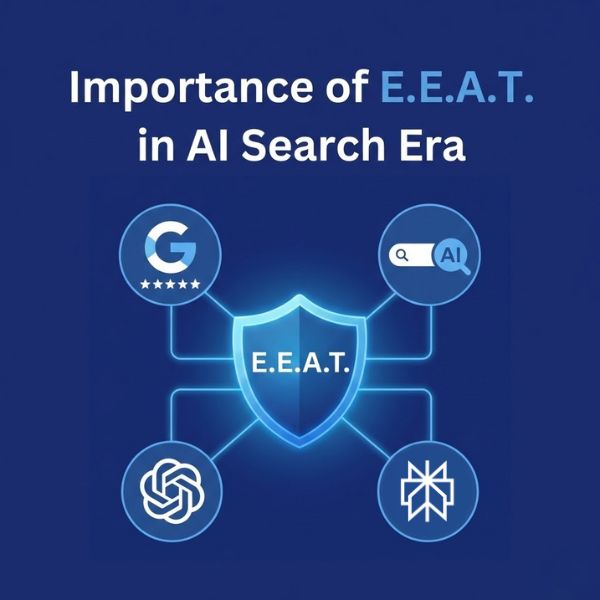
- Importance of EEAT in AI Search Era
- Why EEAT Is No Longer Just a Google Guideline?
- AI Search Changed the Rules of Visibility
- EEAT as a Trust Filter in AI Search Systems
- How Experience, Expertise, Authority, and Trust Work in AI Search?
- Human Trust vs Machine Trust: What’s the Difference?
- The Cost of Ignoring EEAT in the AI Search Era
- EEAT Beyond Google: AI Search Is Everywhere
- Final Takeaway
For more than a decade, not much has changed in the fundamentals of speaking to Google’s algorithm. The 2014 rollout of the site’s Search Quality Rater Guidelines introduced E-A-T; Since then, Google has ranked almost all indexed content based on expertise, authoritativeness, and trustworthiness.
However, as the best SEO company in India, we have observed that the landscape recently shifted. AI and LLMs have significantly transformed how we interact with search, making information more accessible than ever. This shift makes it difficult for many websites to regain their previous visibility. But even with AI-generated summaries, Google still needs reliable information. That’s when EEAT comes in.
In 2022, Google welcomed the AI era by adding a new metric, ‘Experience’, to E-A-T, intending to help creators utilise new technologies effectively. Google also mentioned, “Our ranking systems aim to reward original, high-quality content that demonstrates qualities of what we call E-E-A-T: expertise, experience, authoritativeness, and trustworthiness.”
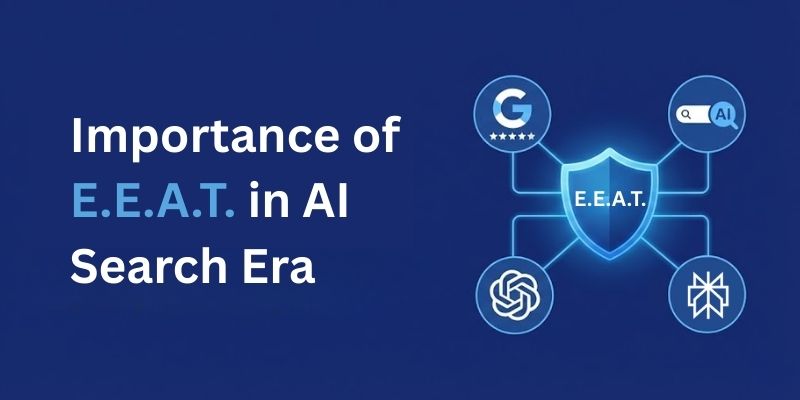
Therefore, to maintain visibility in search, especially in AI-generated answers, you must ensure your content fulfils all four qualities of E-E-A-T. In this blog, we will focus on the importance of EEAT in the AI search era.
Why EEAT Is No Longer Just a Google Guideline?
In 2026, the Google EEAT guidelines aren’t just a long document for human quality raters; they’ve evolved into a universal trust framework for the entire AI ecosystem. With the advent of Artificial Intelligence, AI-generated content is saturating the web. Thus, EEAT in SEO serves as a:
- Technical filter to prevent hallucinations and verify accuracy before citing sources.
- Reputation engineering by establishing your brand as a verified entity in SEO that AI models can safely recommend.
- Proof of human origin by prioritising human experience through the first E (experience) over automated text.
- Cross-platform standards because the EEAT principles are now also used by other platforms like Perplexity AI and Bing AI to verify the safety and reliability of the information across ecosystems.
AI Search Changed the Rules of Visibility

The evolution of AI search has fundamentally rewritten the rules of digital visibility. As search becomes more generative, visibility no longer just means achieving ranking on the SERPs. It simply means AI systems selecting, trusting, and reusing your content inside AI-generated answers.
The rise of AI search in SEO does not introduce an entirely new framework; instead, it changes how existing SEO signals are interpreted. According to Originality AI, “AI Overviews prioritise EEAT above traditional SEO, with 52% of citations coming from sites not found in the Top-100 ranked SERP.” Understanding this, brands are also increasingly competing for inclusion rather than optimising for clicks, choosing citability over rankings.
Visibility shifts from: “Where do I rank?” to “Am I part of the answer?” This fundamental shift highlights the difference between SEO vs GEO, where visibility now includes AI systems explaining, summarising, and recommending your brand, regardless of whether a click ever occurs.
EEAT as a Trust Filter in AI Search Systems
EEAT significantly serves as a technical trust filter in the AI search algorithms to prevent hallucinations. It guides algorithms to surface high-quality, reliable content by assessing first-hand experience, deep knowledge, and overall trustworthiness, distinguishing human-written content from automated output.
Why EEAT Is No Longer Just a Google Guideline?
One of the most vital reasons AI models are risk-averse by design is that they often hallucinate, creating facts that might sound real but are wrong. To stop this, search engines program AI to be safety-first.
By following EEAT principles, search engines prioritise
- Safety over novelty by preventing the spread of misinformation and preferring content that is widely accepted.
- Fact-checking by relying only on trusted, verified, and authoritative sources.
- Avoiding spam by training AI algorithms to penalise content with keyword stuffing or one created purely for ranking purposes during AI content detection.
Therefore, by being risk-averse, AI stays reliable and avoids spreading harmful lies.
Why Low-Trust Content Rarely Appears in AI Answers?
AI can produce huge amounts of text, but not necessarily content that people trust. Low-trust content does not appear frequently in AI answers because the latest AI models are programmed for accuracy, safety and reliability, intentionally filtering out sources that show signs of being low-quality or misleading.
This helps avoid garbage-in, garbage-out traps and prevents the spread of misinformation. EEAT serves as a quality gatekeeper, as AI often synthesises multiple sources into a single answer. If any website lacks clear topical authority, real-world experience and expert citations, then AI views it as a risk.
Thus, to protect users, especially when dealing with sensitive content, AI ignores unverified pages and prefers only highly credible sources for answers.
How Experience, Expertise, Authority, and Trust Work in AI Search?
EEAT serves as one of the most crucial frameworks for AI search to identify high-quality, reliable content, with AI systems prioritising website credibility, real-world experience, deep expertise, authoritativeness, and trustworthiness.
Experience: Why First-Hand Knowledge Matters More Than Ever?
Experience is the real differentiator, especially in the AI world, where AI cannot replicate first-hand human involvement. Experience proves that content was created by someone who has actually done or tested what they’re writing about. This is why AI models prioritise content backed by first-hand knowledge.
Businesses that showcase real-world expertise through original research, case studies, or hands-on experience are more likely to be cited.
Expertise: How AI Identifies Subject-Matter Depth?
Expertise means the content is created or reviewed by someone qualified. AI identifies expertise by analysing professional credentials, technical accuracy, and information gain from existing data. The generated answers usually prefer sources with clear subject-matter expertise.
Expertise is reflected in AI-driven search results through author bylines, credentials, and expert contributions.
Authority: Why Brands and Authors Matter More Than Pages?
You earn authority via consistency, recognition, and external validation. Today, AI search focuses significantly on brands and authors for brand authority SEO rather than individual pages. Search engines often measure this through reputation engineering, assessing how frequently reputable third-party sources cite your experts.
The platform prioritises brands that own their knowledge base, are widely referenced, and are recognised leaders in their industry.
Trust: The Foundation AI Systems Refuse to Compromise On
Trust is non-negotiable in AI search. Google emphasises trust as one of the most essential components of EEAT. The AI-generated content is acceptable to use up to a specific limit, but it must be factually accurate and verifiable. Unverifiable and low-trust content gets automatically bypassed by AI engines to protect user safety.
Human Trust vs Machine Trust: What’s the Difference?

Human trust includes authority, credibility, and emotional connection, which are mainly built on brand loyalty and shared values. Whereas machine trust involves data consistency, technical validation and EEAT signals generated by algorithms.
The core difference between the two is that human trust can be earned through high-quality, authentic, and relatable content. In contrast, machine trust can be achieved through structured data, security, and technical signals.
Signals Humans Trust
Human trust significantly relies on emotional connection and social proof. A few of the human trust signals that users usually look for are:
- Personal stories
- Relatable brand stories
- Authentic social proof, like reviews or video testimonials
- Shared values
- User-generated content
This helps create a sense of safety that builds long-term brand loyalty and drives conversions.
Signals AI Systems Trust
AI systems tend to trust technical, verifiable E-E-A-T signals, as they primarily rely on data and objective criteria. They scan for:
- Technical directives (defining what is llms.txt)
- Structured schema markup
- Professional credentials
This is done to ensure factual accuracy and prevent hallucinations in the AI-generated answers.
The Cost of Ignoring EEAT in the AI Search Era
Neglecting EEAT investment causes tangible problems in the AI search era:
- Low Visibility: Your content might not be included in AI-generated summaries, which ultimately means fewer clicks and less traffic.
- Loss of Credibility: Low-quality or low-trust content without author names, credentials, or sources can make your site seem untrustworthy.
- Algorithmic penalties: According to Google, algorithms likely downgrade content lacking E-E-A-T, especially in sensitive topics.
In short, ignoring EEAT in the AI search era can cost you significantly.
Why Does AI Skip “Good” but Untrusted Content?
AI systems simply prioritise AI content safety over style. Your content might be well-structured and well-written, but if it lacks verifiable credentials or experience markers, it is treated as a hallucination risk. The system works by predicting patterns in its training data and filtering content based on reliability.
How AI Content Flooding Makes EEAT a Survival Signal?
Did you know that AI generated more than 57% of webpage content in 2024? This has increased rapidly in 2025. This AI content flooding has created a content saturation crisis, reducing the value of generic, SEO-optimised content.
As low-effort, recycled content floods the internet, Google and other platforms have shifted their focus from content quantity to authenticity. And in this situation, EEAT SEO has emerged from a best practice to a survival signal, because it acts as a key differentiator between trustworthy human-written content and automated content.
EEAT Beyond Google: AI Search Is Everywhere
EEAT principles aren’t just restricted to Google; they are used by other AI platforms as well. AI search engines like Bing, Perplexity and others have adopted EEAT as a universal reliability standard. These platforms use it to verify user trust signals before synthesising answers, making EEAT essential for the entire AI ecosystem, not just for Google AI Overviews.
EEAT Signals in AI Overviews and Answer Engines
Answer engine optimisation (AEO) and AI Overviews optimisation require EEAT as a citation gatekeeper. The signals act as a quality indicator to select reliable sources for AI-generated answers, especially for sensitive topics or YMYL SEO.
Some key signals include information gain, entity footprint, knowledge graph alignment and experience proof. AI models always focus on structured, expert and first-hand experience content to verify facts.
Why EEAT Matters for LLM-Based Search Experiences?
Brands leveraging LLM SEO services know that EEAT is vital for LLM-based search experiences, as it serves as a foundation for AI reliability, trust, and content curation. These models use trust signals in SEO as a grounding mechanism, prioritising verified experts to ensure factual accuracy. Models consider the unavailability of these markers a safety risk and exclude such content entirely from AI-generated summaries.
Final Takeaway
The importance of EEAT in the AI search era cannot be understated. E-E-A-T is the key to visibility in AI-driven search; it’s not just about optimisation. Businesses must become the expert sources AI models trust, reference, and cite.
Hence, businesses that invest in expertise, credibility, and real-world authority will survive in this AI search era. As AONE SEO Service, the best SEO company in Ahmedabad, we ensure your brand remains the expert source AI models trust. Contact us today to future-proof your visibility before you fade away and become irrelevant.