

Table of Content
- Why Content Freshness Matters in AI Search
- What Content Freshness Means in AI Search
- Beyond Publish Date: The Three Layers of Freshness
- Why AI Search Prioritises Fresh Content
- Freshness Is Query Dependent: Not All Content Needs Constant Updates
- Biggest Content Freshness Mistakes Brands Make
- How to Build a Practical Content Freshness Strategy
- Conclusion
- FAQs
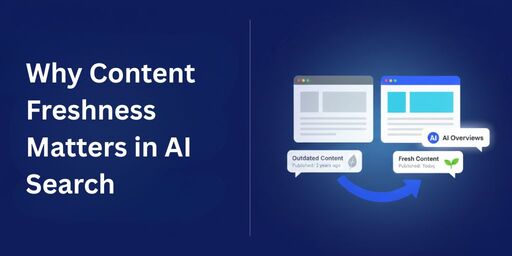
In the world of AI search, content behaves a lot like perishable goods. It has an expiration date. This is because AI systems tend to treat ‘freshness’ as a primary signal of authority. Unlike traditional search, where an old article might remain relevant due to its history and backlinks, modern AI search engines prioritise real-time information and relevance.
Fresh content has always played an essential role in SEO, but it is even more critical in AI search. The term “fresh content” might seem like a buzzword, yet its significance is often misunderstood.
“AI-cited content is 25.7% fresher than traditional organic Google results.” — Ahrefs study analysing 17 million citations across ChatGPT, Perplexity, Gemini, Copilot & Google AI Overviews
AI-driven systems don’t just retrieve information: they synthesise it. To ensure accuracy, they prefer the most up-to-date, reliable, and contextually relevant sources. When your content sits stagnant, its value decreases in the eyes of algorithms, signalling that your expertise may no longer be active or accurate. This means outdated pages risk being ignored by modern AI engines.
Therefore, understanding modern AI search ranking factors is essential for staying ahead of shifting algorithm preferences. In this blog, we will explore why content freshness matters in AI search and, more importantly, what you can do about it.
What Content Freshness Means in AI Search
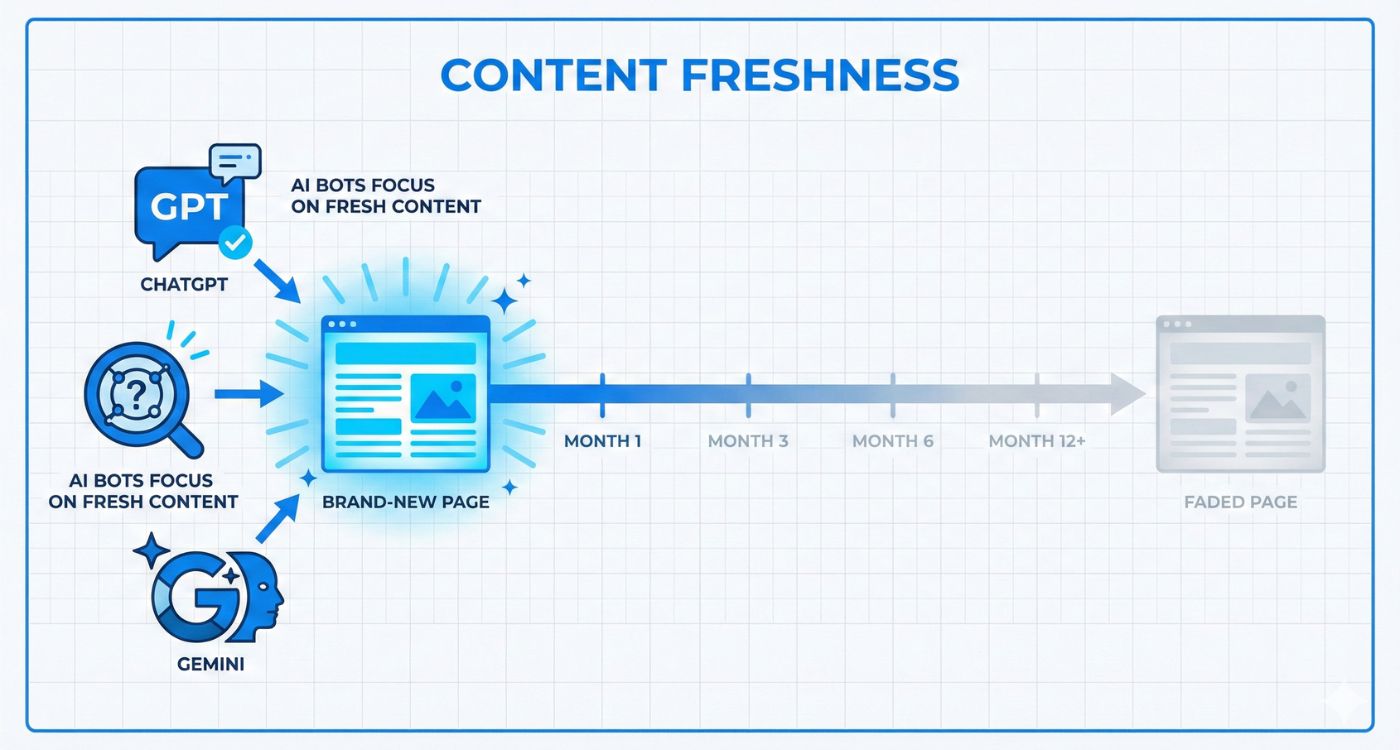
Content freshness, or fresh content, simply means how new or recently updated a page or piece of content is on your website. This could be a brand-new blog post, an updated service page, or freshly added videos and images. It extends beyond text: any new element introduced to your site can be considered fresh content.
Freshness is not just about the date the content was published; it’s about ongoing content relevance and information accuracy. When you keep your content up to date, it signals to platforms like Google and AI assistants that your information is current, reliable, and helpful: which helps you maintain good rankings and earn more mentions.
As AI assistants and search engines continue to prioritise data recency, one of the easiest and most effective ways to stay visible and competitive is by regularly updating your content.
Beyond Publish Date: The Three Layers of Freshness
In AI search, content freshness is no longer just about the publish date. AI models analyse how well your content matches the current topical landscape using three critical layers:
1. Factual Accuracy (The Truth Layer)
AI systems continuously cross-reference your claims against a massive, global knowledge graph. If your content contains outdated facts, AI can identify factual decay. Even when the content has a recent publish date, stale data triggers a trust penalty.
2. Semantic Relevance (The Language Layer)
This layer focuses on language evolution: the evolution of terminology and professional discourse over time. AI uses vector embeddings to assess whether your terminology aligns with current professional discourse. If your content still uses outdated buzzwords, AI perceives this as a semantic gap, making it appear less authoritative to modern users.
3. Intent Fulfilment (The Utility Layer)
In this layer, AI assesses whether your content still solves the user’s problem in today’s context. For instance, a technical guide published two years ago might be factually correct, but it’s practically useless if the software has been updated. True freshness aligns with shifting users’ search intent evolution, ensuring it is the best possible solution for the current query.
Why AI Search Prioritises Fresh Content

To Avoid Outdated or Incorrect AI Answers
AI models focus on minimising hallucinations and factual errors. As they cross-reference your content against a live knowledge graph, any presence of factual decay marks your site as unreliable. Freshness helps ensure that the generative search results remain accurate and trustworthy for users.
To Match Rapidly Changing User Intent
With technological evolution, user needs also evolve. AI tends to prioritise content that reflects utility, ensuring the solution provided matches the modern context of the user’s query. To understand how AI engines evaluate this, read our guide on how to rank on AI Overviews, ChatGPT, and Perplexity AI.
To Strengthen Trust and Authority Signals
Regular updates signal to the AI that the brand is an active, authoritative expert in its field. It helps you address semantic drift: the gap between old terminology and current discourse. Updated content also improves E-E-A-T signals and maintains high topical authority in the eyes of sophisticated LLMs. This is closely tied to Generative Engine Optimisation (GEO), which focuses on positioning your content as a trusted source for AI-generated answers.
Freshness Is Query Dependent: Not All Content Needs Constant Updates
Search engines like Google and AI systems use ‘Query Deserves Freshness’ (QDF), which is designed to show fresher content for the search queries where it would be expected. It depends significantly on the search intent.
High Freshness Topics
In these topics, information can become obsolete within days, hours, or even minutes. Some high-freshness topics include:
- Breaking news: political updates, natural disasters, or global events
- Dynamic data: stock market prices, crypto trends, and exchange rates
- Recurring events: sports scores, award show winners, and seasonal festival dates
Medium Freshness Topics
These topics tend to evolve steadily and usually require an update every 6 to 12 months. A few medium freshness topics include:
- Product reviews: especially ‘best of’ lists for tech, appliances, or software
- Industry reports: including annual rankings, statistics, and forecasts
- Software tutorials: that may need updates following a new release
Low Freshness Topics
Often called ‘evergreen content’, these topics are based on facts that rarely change. Some low-freshness topics include:
- Historical facts: timelines of historical figures or past events
- Fundamental science: principles of physics, mathematical formulas, or biological classifications
- Foundational philosophies: concepts of stoicism, logic, or ethics
Biggest Content Freshness Mistakes Brands Make
To achieve content freshness, it is important to avoid faking it: this is a high-risk strategy. Nowadays, AI models are sophisticated enough to detect whether a page has been superficially altered or meaningfully improved. Here are some of the biggest content freshness mistakes that brands usually make:
Updating Dates Without Updating Value
Brands should avoid the trap of ‘ghost updates’, which involves simply changing the “last updated” date in their CMS without touching the actual content. AI engines can easily detect this by comparing the current page to its previously cached state. Your site may even face a trust penalty if the information density hasn’t increased.
Rewriting Without Adding New Information
A common mistake is re-spinning the text or paraphrasing the sentence structure whilst keeping the same outdated facts. Using vector embeddings, AI can understand a page’s core concepts. For AI, rewriting without new data is just a redundant version of old content.
Treating Evergreen Content as Untouchable
Brands need to understand that evergreen content does not mean permanent. They often ignore their best-performing historical pieces, assuming the facts are timeless. However, even foundational topics suffer from semantic drift as new research, cultural contexts, and modern examples emerge.
Freshness Is Query Dependent: Not All Content Needs Constant Updates
Search engines like Google and AI systems use ‘Query Deserves Freshness’ (QDF), which is designed to show fresher content for the search queries where it would be expected. It depends significantly on the search intent.
High Freshness Topics
In these topics, information can become obsolete within days, hours, or even minutes. Some high-freshness topics include:
- Breaking news: political updates, natural disasters, or global events
- Dynamic data: stock market prices, crypto trends, and exchange rates
- Recurring events: sports scores, award show winners, and seasonal festival dates
Medium Freshness Topics
These topics tend to evolve steadily and usually require an update every 6 to 12 months. A few medium freshness topics include:
- Product reviews: especially ‘best of’ lists for tech, appliances, or software
- Industry reports: including annual rankings, statistics, and forecasts
- Software tutorials: that may need updates following a new release
Low Freshness Topics
Often called ‘evergreen content’, these topics are based on facts that rarely change. Some low-freshness topics include:
- Historical facts: timelines of historical figures or past events
- Fundamental science: principles of physics, mathematical formulas, or biological classifications
- Foundational philosophies: concepts of stoicism, logic, or ethics
Biggest Content Freshness Mistakes Brands Make
To achieve content freshness, it is important to avoid faking it: this is a high-risk strategy. Nowadays, AI models are sophisticated enough to detect whether a page has been superficially altered or meaningfully improved. Here are some of the biggest content freshness mistakes that brands usually make:
Updating Dates Without Updating Value
Brands should avoid the trap of ‘ghost updates’, which involves simply changing the “last updated” date in their CMS without touching the actual content. AI engines can easily detect this by comparing the current page to its previously cached state. Your site may even face a trust penalty if the information density hasn’t increased.
Rewriting Without Adding New Information
A common mistake is re-spinning the text or paraphrasing the sentence structure whilst keeping the same outdated facts. Using vector embeddings, AI can understand a page’s core concepts. For AI, rewriting without new data is just a redundant version of old content.
Treating Evergreen Content as Untouchable
Brands need to understand that evergreen content does not mean permanent. They often ignore their best-performing historical pieces, assuming the facts are timeless. However, even foundational topics suffer from semantic drift as new research, cultural contexts, and modern examples emerge.
How to Build a Practical Content Freshness Strategy
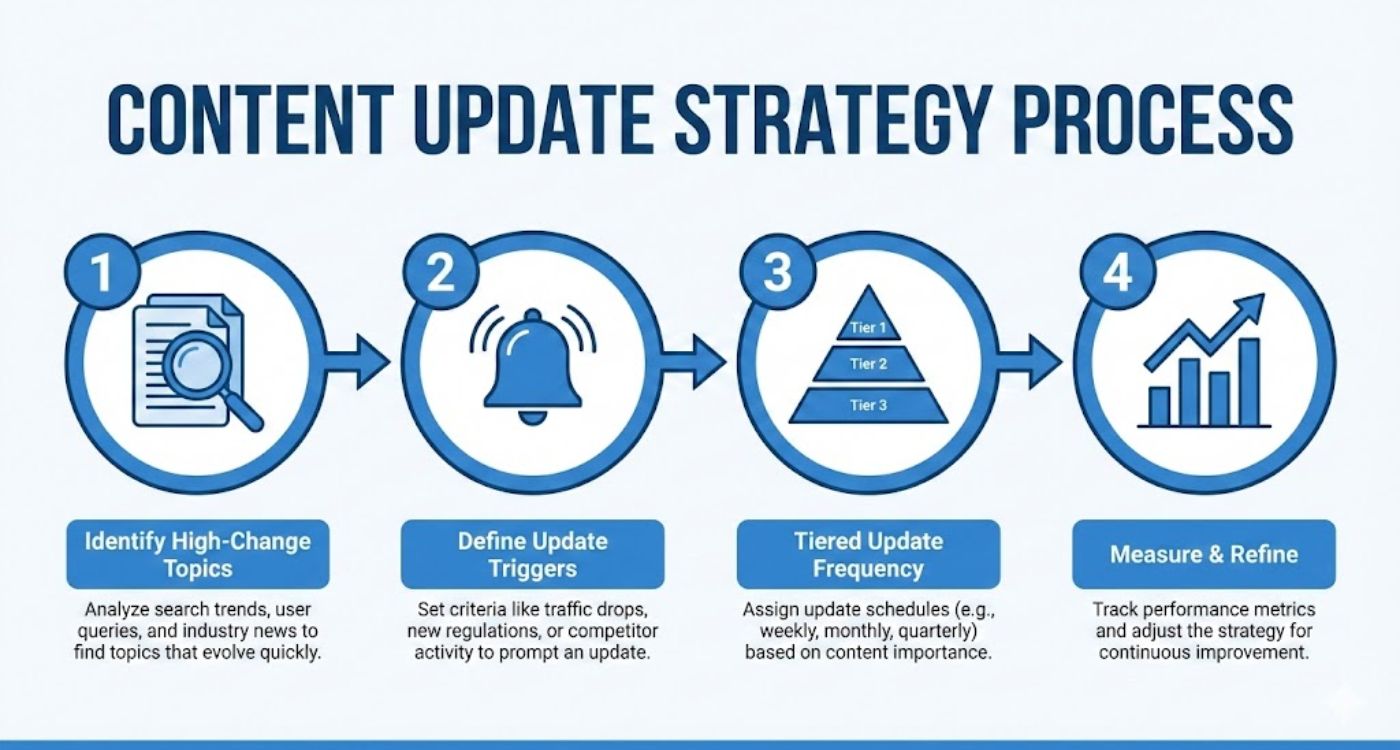
Here’s how you can build a practical content update strategy that keeps your content visible in AI search:
Step 1: Identify High-Change Topics
First, categorise your content by decay rate. With tools like Google Search Console, you can identify pages where traffic is dipping despite high historical rankings. Focus on high-change topics such as regulations, technology, or fast-moving market trends, where factual accuracy is the primary ranking factor.
Step 2: Define Update Triggers
Rather than following a strict calendar, create event-based triggers. An update should be triggered whenever:
- A new industry or government report is released
- Industry software undergoes significant changes
- Your internal data or product pricing changes
Step 3: Use Tiered Update Frequency
Not every piece of content requires the same level of attention. Implement a tiered maintenance schedule as part of your content lifecycle management to optimise your resources:
- Tier 1 (Monthly/Quarterly): News-heavy topics and high-traffic money pages that drive the maximum conversions.
- Tier 2 (Bi-Annually): ‘Best of’ lists and instructional guides that need current examples and links.
- Tier 3 (Annually): Evergreen content that requires a semantic check to ensure the language still feels modern.
For a deeper understanding of how AI search systems evaluate and cite content, explore our blog on what llms.txt is and how it guides AI bots to your best content.
Conclusion
Content that stays fresh stays visible in AI search. In the era of AI search, the most successful brands won’t be those that publish the most content: they’ll be the ones that keep it alive. Because in the AI era, more than what you say, it’s when you last said it that matters.
If you’re ready to refresh your content and make your digital presence known in AI search, AONE SEO Service is here to help. As the best SEO company in India, we understand that timing is everything: so we focus on continuous optimisation to ensure your content never loses its relevance or its rank.
FAQs
Does updating content improve visibility in AI search results?
Yes, regularly updating your content is critical to maintaining high topical authority and improving visibility in AI search results. It signals to AI models that your content is up to date, increasing the chances of being cited in AI-generated summaries and recommendations.
How do AI search engines determine if content is fresh?
AI search engines utilise several technical and semantic signals to assess freshness, such as visible dates, crawl frequency, fact comparison, and the Query Deserves Freshness (QDF) framework.
How often should content be updated for AI search optimisation?
The ideal frequency to update your content for AI search optimisation depends on your content type. Time-sensitive content should be updated as soon as new data is available; high-performing pages should be updated at least every 3 to 6 months; and evergreen content should be refreshed at least once every 12 months.
Is content freshness more important than backlinks in AI search?
They are equally essential. Backlinks establish your site’s authority and trust; freshness ensures your information is relevant. An authoritative site with outdated data will eventually lose its AI ranking.
Can evergreen content still perform well in AI search?
Absolutely. Evergreen content performs best when it’s periodically updated. Adding new examples, current statistics, or updated FAQs ensures that AI continues to view the core information as the most relevant.
What are the biggest content freshness mistakes to avoid?
The biggest content freshness mistakes that every brand should avoid include faking freshness, updating dates without updating content value, rewriting without adding new information, and treating evergreen content as untouchable.